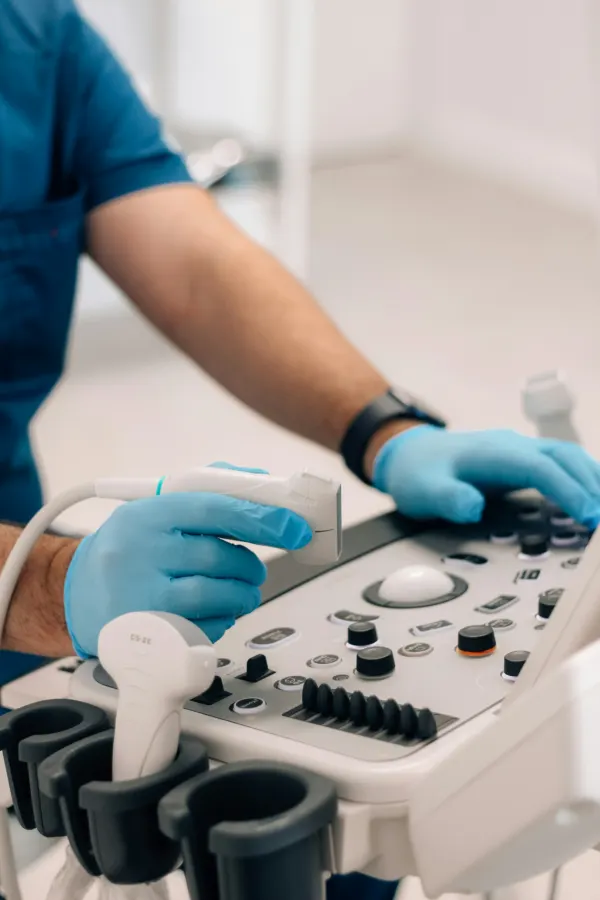
Ultrasonography (USG) is an imaging method that does not use ionising radiation; it assesses organs and soft tissues using images formed by high-frequency sound waves reflected from the tissues.
At CityMed Imaging Centre, Toshiba and General Electric ultrasound systems are used with probes suited to different anatomical regions. Because images are obtained instantly, the structure and movement of organs can be observed in real time.
Abdominal organs, the thyroid and neck, breasts, pelvic organs, testes, soft tissues, muscles and tendons can be assessed by ultrasound according to clinical need. Where required, the examination is complemented by colour Doppler to provide additional information on blood vessels and blood flow.
Important: Ultrasound does not use X-rays and can be safely performed in many situations, including pregnancy. Nevertheless, the examination should be carried out for a medical indication and for the shortest time necessary.
TECHNOLOGY
High resolution.
The right probe.
No ionising radiation
USG
Toshiba and GE systems
2
Blood-flow assessment
Doppler
High-frequency linear probes are used for superficial tissues and convex probes for deep-seated organs. For suitable lesions, advanced applications such as elastography can contribute to the diagnostic assessment.
Current availability of advanced applications and patient suitability should be confirmed before your appointment.
EXAMINATION AREAS
Different regions.
Targeted examination.
The region examined is selected according to your symptoms and your doctor's request.
01 / ABDOMEN
Whole abdominal ultrasound
Assessment of the liver, gallbladder, pancreas, spleen, kidneys and bladder.
02 / NECK
Thyroid and neck ultrasound
Examination of the thyroid gland, nodules, salivary glands and cervical lymph nodes.
03 / WOMEN'S HEALTH
Breast ultrasound
Assessment of breast tissue and the armpit; a complementary examination to mammography.
04 / PELVIS
Pelvic ultrasound
Assessment of the uterus, ovaries, bladder and prostate according to the clinical question.
05 / UROLOGY
Scrotal (testicular) ultrasound
Assessment of the testes and surrounding tissues; Doppler evaluation of blood supply when required.
06 / MUSCULOSKELETAL
Soft tissue and joint ultrasound
Dynamic assessment of muscles, tendons, ligaments and superficial masses.
The region to be examined is determined by your doctor's request. Availability of advanced applications at the centre should be confirmed separately.
PATIENT GUIDE
How to prepare
for an ultrasound.
01 / BEFORE
Region-specific preparation
Abdominal ultrasound usually requires 6–8 hours of fasting. Pelvic and bladder examinations may require a full bladder. Thyroid, breast and soft tissue examinations generally need no special preparation.
02 / DURING
Gel and probe
A water-based gel is applied to the area and the probe is moved over the skin. You may be asked to change position or briefly hold your breath.
03 / AFTER
Back to daily life
You can return to normal activities immediately after a diagnostic ultrasound. The images are interpreted and reported by a radiologist.
Good to know
Previous examinations: Bringing previous ultrasound, CT or MRI reports helps with comparative assessment.
Personal instructions: Preparation rules vary by examination type; always follow the instructions given by the centre.
FREQUENTLY ASKED QUESTIONS
Questions about
ultrasound.
Does ultrasound involve radiation?
No. Ultrasound creates images with sound waves; no ionising radiation is used.
Do I need to fast for an abdominal ultrasound?
Fasting for 6–8 hours is usually recommended. Exact preparation details are given when you book.
Is an ultrasound painful?
No. The examination is painless; only light pressure may be applied with the probe.
How long does an ultrasound take?
It varies with the region examined, but most examinations are completed in a short time.
What is the difference between ultrasound and Doppler?
Ultrasound shows the structure of organs; Doppler adds information about blood flow within the vessels.
Can ultrasound be performed during pregnancy?
Yes. Ultrasound can be used during pregnancy; the examination should be performed for a medical indication.
CITYMED FULYA
A careful approach
to imaging.
Hakkı Yeten Cd.
Unimed Business Centre No:19, Floor B1
34394 Şişli / Istanbul, Türkiye
GET DIRECTIONS
How can we help you?
Choose a topic and your message will open ready to send on WhatsApp. We reply as soon as possible during working hours.